

Use the Prompt
Add Your Brief
Add your context below. It will be included with the prompt when you copy or download.
Create an editable HTML/CSS composition with selectable text and a print stylesheet; treat any raster illustration as a separate local asset for [PROJECT] and [AUDIENCE]. The task is: Quote Social Card.
Required content and structure
Set an approved quotation with accurate attribution and a readable typographic hierarchy.
Use [APPROVED_CONTENT] as the source of names, dates, figures, claims and destinations. List missing inputs before substituting anything. If a demonstration is needed, label its content as fictional. Do not invent customer quotes, rankings, partner logos or product capabilities.
Design direction
Use [BRAND_RULES] and the design system already selected in the project. If no system is supplied, start with this direction: muted lavender, ink typography and apricot accents; thoughtful negative space and a distinctive visual motif. Keep type, spacing and color roles consistent. Prioritize the task over decorative elements and avoid a generic collection of unrelated cards.
Content preparation
Use the exact approved quotation, attribution, source context and any permissions information. Decide whether shortening is allowed before adapting the text.
Layout and behavior
Let typography establish hierarchy between the quotation and its author. Preserve meaningful punctuation and line breaks, with attribution readable at the intended display size.
Task-specific acceptance check
- Do not shorten the quote in a way that changes its meaning.
- Compare the finished wording with the original.
- A crop or line break must not change the quotation's meaning, and an unattributed sample should not acquire a famous person's name.
Implementation and review
Keep text editable. Use semantic structure, descriptive controls, visible keyboard focus and appropriate empty/error states. Check narrow and wide layouts. Respect reduced-motion preferences. Preserve any existing project framework and dependencies; do not silently replace the stack. Return the editable files and explain any incomplete behavior or unsupported inputs. Review this specific task before proposing extra features.
Keep exact text and required credits as live text. Ask for the intended dimensions when they are missing. Do not invent a functional QR code, barcode, signature or official seal.
Reference attachment and reconstruction goal
Attach reference.webp from this prompt’s download bundle alongside this prompt in OpenDesign. Build an editable result with a similar composition and hierarchy; do not embed the whole reference image as the finished interface. Preserve approved project content and brand rules if they conflict with fictional sample labels. If the image is missing or unreadable, ask for it instead of claiming visual fidelity.
Reference composition and content
Use the attached reference.webp as the visual reference for Quote Social Card. Before building, identify the major regions from top to bottom, their relative widths and heights, alignment, spacing, typography hierarchy, surface colors, borders, imagery and repeated components. Preserve those relationships rather than substituting a generic template. Required task content: Set an approved quotation with accurate attribution and a readable typographic hierarchy. Use the following task-specific layout guidance when translating the image into editable elements: Let typography establish hierarchy between the quotation and its author. Preserve meaningful punctuation and line breaks, with attribution readable at the intended display size.
Visual direction from the example brief
Let typography establish hierarchy between the quotation and its author. Preserve meaningful punctuation and line breaks, with attribution readable at the intended display size.
Output and editability
Recreate the finished graphic as editable text, shapes and image layers. The reference is a composition, not an editor interface; do not add navigation, forms or dashboard widgets that are absent from it. Let typography establish hierarchy between the quotation and its author. Preserve meaningful punctuation and line breaks, with attribution readable at the intended display size. Confirm intended dimensions and preserve text hierarchy when adapting the artwork. Do not shorten the quote in a way that changes its meaning.
Visual comparison and delivery
- Compare the result with the attached image at matching proportions. Review major region placement, relative image sizes, line breaks, spacing, typography hierarchy, contrast, active states and content density before polishing decorative details.
- Then test the narrow layout without squeezing desktop text into tiny labels.
- Keep logos, photos and icons as separate assets and all meaningful labels editable. List any unavailable fonts/assets and any intentional departures. Return the working files plus a concise account of implemented behavior and remaining integrations; do not promise a pixel-identical result from the prompt alone.
Download Prompt + Image
Includes the complete prompt and full-size reference image. Attach both in OpenDesign to guide the layout.
How to Write a Quote Social Card Design Prompt
Use this quote social card design prompt to set an approved quotation with accurate attribution and a readable typographic hierarchy.
The reference is an AI-generated concept. The instructions below describe what to build and test; the image does not demonstrate working behavior.
Preserve the Meaning of the Quotation
A quote card relies on exact wording and attribution.
Enlarging a memorable fragment can change the meaning when the original qualification is removed. Let typography establish hierarchy between the quotation and its author. Preserve meaningful punctuation and line breaks, with attribution readable at the intended display size.
From the Prompt
Let typography establish hierarchy between the quotation and its author.
Make It Your Own
Set [APPROVED_QUOTE] as live text and pair it with [ATTRIBUTION]. Preserve punctuation and necessary context; adjust spacing before shortening the quotation.
Prepare the Quote Social Card Content
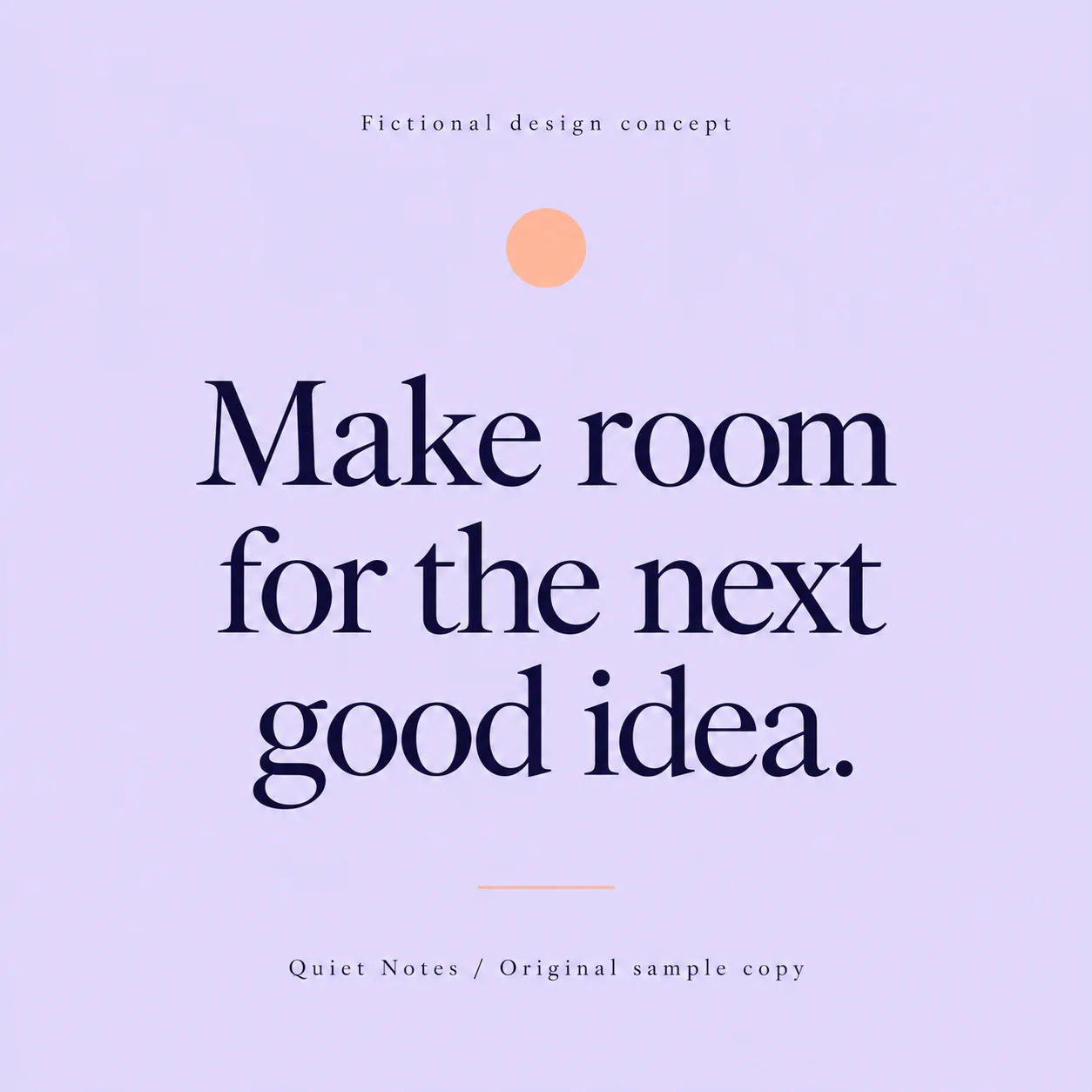
The quotation occupies the center with generous whitespace; preserve the approved wording and test legibility at feed-thumbnail scale.
Use the exact approved quotation, attribution, source context and any permissions information. Decide whether shortening is allowed before adapting the text.
From the Prompt
Set an approved quotation with accurate attribution and a readable typographic hierarchy.
Make It Your Own
For [PROJECT], use [APPROVED_CONTENT] as the source for this quote social card. Use the exact approved quotation, attribution, source context and any permissions information. Decide whether shortening is allowed before adapting the text. Identify missing inputs before replacing them with demonstration content.
Read It Against the Source
Attribution is separated by a short rule; supply a verified source or clearly label original sample copy.
Compare the final card word for word with the supplied quotation. Check a long attribution at feed size without reducing it to an unreadable footnote. Compare the finished wording with the original. A crop or line break must not change the quotation's meaning, and an unattributed sample should not acquire a famous person's name.
From the Prompt
Do not shorten the quote in a way that changes its meaning.
Make It Your Own
Review the quote social card against this requirement: Do not shorten the quote in a way that changes its meaning. Compare the finished wording with the original. A crop or line break must not change the quotation's meaning, and an unattributed sample should not acquire a famous person's name. Preserve approved content and revise only the parts that fail this check.
Review Your Quote Social Card Result
A visual concept is not a press-ready or platform-approved file. Check exact copy, dimensions, color handling, fonts, asset rights and final placement.
- Compare the finished wording with the original. A crop or line break must not change the quotation's meaning, and an unattributed sample should not acquire a famous person's name.
Follow-Up Prompt
Use this after the first result. It narrows the revision to the most important part of this task.
Refine the current quote social card. Compare the finished wording with the original. A crop or line break must not change the quotation's meaning, and an unattributed sample should not acquire a famous person's name. Preserve the approved content and visual direction; change only the parts needed to resolve these issues.