
Use the Prompt
Add Your Brief
Add your context below. It will be included with the prompt when you copy or download.
Create an editable HTML presentation with a 16:9 canvas, previous/next buttons, arrow-key navigation, a slide counter and a one-slide-per-page print layout for [PROJECT] and [AUDIENCE]. The task is: Startup Pitch Deck.
Required content and structure
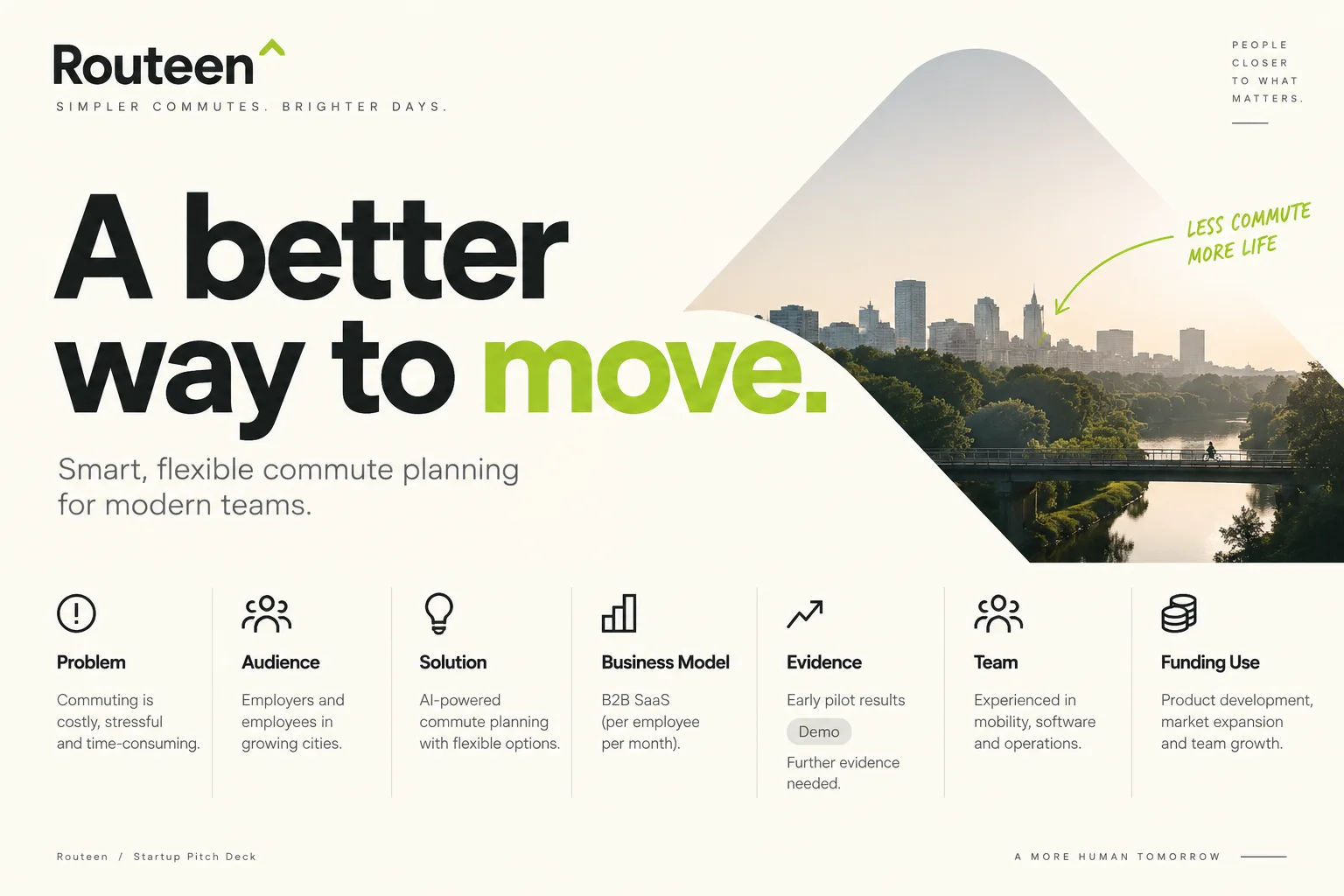
Structure problem, audience, solution, business model, evidence, team and funding use.
Use [APPROVED_CONTENT] as the source of names, dates, figures, claims and destinations. List missing inputs before substituting anything. If a demonstration is needed, label its content as fictional. Do not invent customer quotes, rankings, partner logos or product capabilities.
Design direction
Use [BRAND_RULES] and the design system already selected in the project. If no system is supplied, start with this direction: ivory, charcoal and a single lime accent; oversized headlines, deliberate whitespace and clear information hierarchy. Keep type, spacing and color roles consistent. Prioritize the task over decorative elements and avoid a generic collection of unrelated cards.
Content preparation
Prepare the customer problem, proposed solution, business model, actual traction, team roles and intended funding use. Label projections and assumptions before drafting the story.
Layout and behavior
Build a connected argument from customer need to evidence and the proposed next stage. Keep the ask tied to specific work rather than treating it as a decorative final slide.
Task-specific acceptance check
- Distinguish actual traction from forecasts and label assumptions.
- Check every traction figure and customer claim.
- Forecasts, pilots and paying customers need distinct labels, and a total market estimate must not stand in for evidence of demand.
Implementation and review
Keep text editable. Use semantic structure, descriptive controls, visible keyboard focus and appropriate empty/error states. Check narrow and wide layouts. Respect reduced-motion preferences. Preserve any existing project framework and dependencies; do not silently replace the stack. Return the editable files and explain any incomplete behavior or unsupported inputs. Review this specific task before proposing extra features.
Keep one main idea per slide. Use charts only when actual comparable values are supplied; include units, source dates and limitations. Keep speaker notes separate from visible slide content.
Reference attachment and reconstruction goal
Attach reference.webp from this prompt’s download bundle alongside this prompt in OpenDesign. Build an editable result with a similar composition and hierarchy; do not embed the whole reference image as the finished interface. Preserve approved project content and brand rules if they conflict with fictional sample labels. If the image is missing or unreadable, ask for it instead of claiming visual fidelity.
Reference composition and content
Use the attached reference.webp as the visual reference for Startup Pitch Deck. Before building, identify the major regions from top to bottom, their relative widths and heights, alignment, spacing, typography hierarchy, surface colors, borders, imagery and repeated components. Preserve those relationships rather than substituting a generic template. Required task content: Structure problem, audience, solution, business model, evidence, team and funding use. Use the following task-specific layout guidance when translating the image into editable elements: Build a connected argument from customer need to evidence and the proposed next stage. Keep the ask tied to specific work rather than treating it as a decorative final slide.
Visual direction from the example brief
ivory, charcoal and a single lime accent; oversized headlines, deliberate whitespace and clear information hierarchy.
Slide structure and presentation behavior
Recreate the slide composition as editable title, body, visual and annotation elements. A pictured slide is one view, not evidence of a complete deck. Use the supplied narrative to build any requested additional slides; preserve its typography, margins, color roles and alignment. Build a connected argument from customer need to evidence and the proposed next stage. Keep the ask tied to specific work rather than treating it as a decorative final slide. Keep navigation outside exported slide content. Distinguish actual traction from forecasts and label assumptions.
Visual comparison and delivery
- Compare the result with the attached image at matching proportions. Review major region placement, relative image sizes, line breaks, spacing, typography hierarchy, contrast, active states and content density before polishing decorative details.
- Then test the narrow layout without squeezing desktop text into tiny labels.
- Keep logos, photos and icons as separate assets and all meaningful labels editable. List any unavailable fonts/assets and any intentional departures. Return the working files plus a concise account of implemented behavior and remaining integrations; do not promise a pixel-identical result from the prompt alone.
Adapt the reference to the slide canvas
The attached reference image uses a 3:2 composition. Recompose its editable text, shapes and separate image assets onto the requested 16:9 slide canvas. Preserve hierarchy and readable spacing by adjusting the layout; do not stretch the reference or crop essential content to force it into 16:9. Treat this single concept as a visual direction, not as a completed multi-slide deck.
Download Prompt + Image
Includes the complete prompt and full-size reference image. Attach both in OpenDesign to guide the layout.
How to Write a Startup Pitch Deck Design Prompt
Use this startup pitch deck design prompt to structure problem, audience, solution, business model, evidence, team and funding use.
The reference is an AI-generated concept. The instructions below describe what to build and test; the image does not demonstrate working behavior.
Keep Evidence Distinct from Ambition
A startup pitch deck needs a coherent business argument while making the status of its evidence clear.
Actual traction, forecasts and funding plans serve different purposes. Build a connected argument from customer need to evidence and the proposed next stage. Keep the ask tied to specific work rather than treating it as a decorative final slide.
From the Prompt
Build a connected argument from customer need to evidence and the proposed next stage.
Make It Your Own
Connect problem, audience, solution and business model to supplied traction. Label forecasts and assumptions, then explain the team and proposed use of [FUNDING].
Prepare the Startup Pitch Deck Content
The pitch outlines four different claims; supply evidence and assumptions for each rather than filling columns with slogans.
Prepare the customer problem, proposed solution, business model, actual traction, team roles and intended funding use. Label projections and assumptions before drafting the story.
From the Prompt
Structure problem, audience, solution, business model, evidence, team and funding use.
Make It Your Own
For [PROJECT], use [APPROVED_CONTENT] as the source for this startup pitch deck. Prepare the customer problem, proposed solution, business model, actual traction, team roles and intended funding use. Label projections and assumptions before drafting the story. Identify missing inputs before replacing them with demonstration content.
Audit the Traction Slide
Evidence is marked as a demo and notes further proof is needed; replace it with verified traction or state the gap clearly.
Every metric should include its period and definition. A target or projection should remain visibly different from a measured result even in a compact summary. Check every traction figure and customer claim. Forecasts, pilots and paying customers need distinct labels, and a total market estimate must not stand in for evidence of demand.
From the Prompt
Distinguish actual traction from forecasts and label assumptions.
Make It Your Own
Review the startup pitch deck against this requirement: Distinguish actual traction from forecasts and label assumptions. Check every traction figure and customer claim. Forecasts, pilots and paying customers need distinct labels, and a total market estimate must not stand in for evidence of demand. Preserve approved content and revise only the parts that fail this check.
Review Your Startup Pitch Deck Result
A generated image cannot validate a complete deck or its evidence. Test every slide, keyboard navigation, print layout and any exported file separately.
- Check every traction figure and customer claim. Forecasts, pilots and paying customers need distinct labels, and a total market estimate must not stand in for evidence of demand.
Follow-Up Prompt
Use this after the first result. It narrows the revision to the most important part of this task.
Refine the current startup pitch deck. Check every traction figure and customer claim. Forecasts, pilots and paying customers need distinct labels, and a total market estimate must not stand in for evidence of demand. Preserve the approved content and visual direction; change only the parts needed to resolve these issues.