

Slides
Microbiome Research Presentation Design
Raman Lab's nine-slide research example uses navy dividers, cream evidence slides, and a causal caveat to pace an illustrative gut-sleep argument.

Research Presentation Use Cases
- Research Lab MeetingsPresent study context, methods, findings, and next questions.
- Scientific StorytellingMove an audience from evidence gaps toward cautious claims.
- Cohort Study ReviewsSeparate sample design, measured outcomes, and study limitations.
- Academic Presentation SystemsBuild consistent slides for technical research narratives.
Lab Meeting Deck Highlights
- Nine-Slide NarrativeOrganizes context, gap, design, results, claim, and follow-up.
- Metric ContrastPlaces movement beside null findings and sample coverage.
- Editorial PacingAlternates dense evidence slides with spacious divider moments.
- Caveated ConclusionEnds with a proposed experiment instead of causal certainty.
Gut-Sleep Research Slides
1 / 9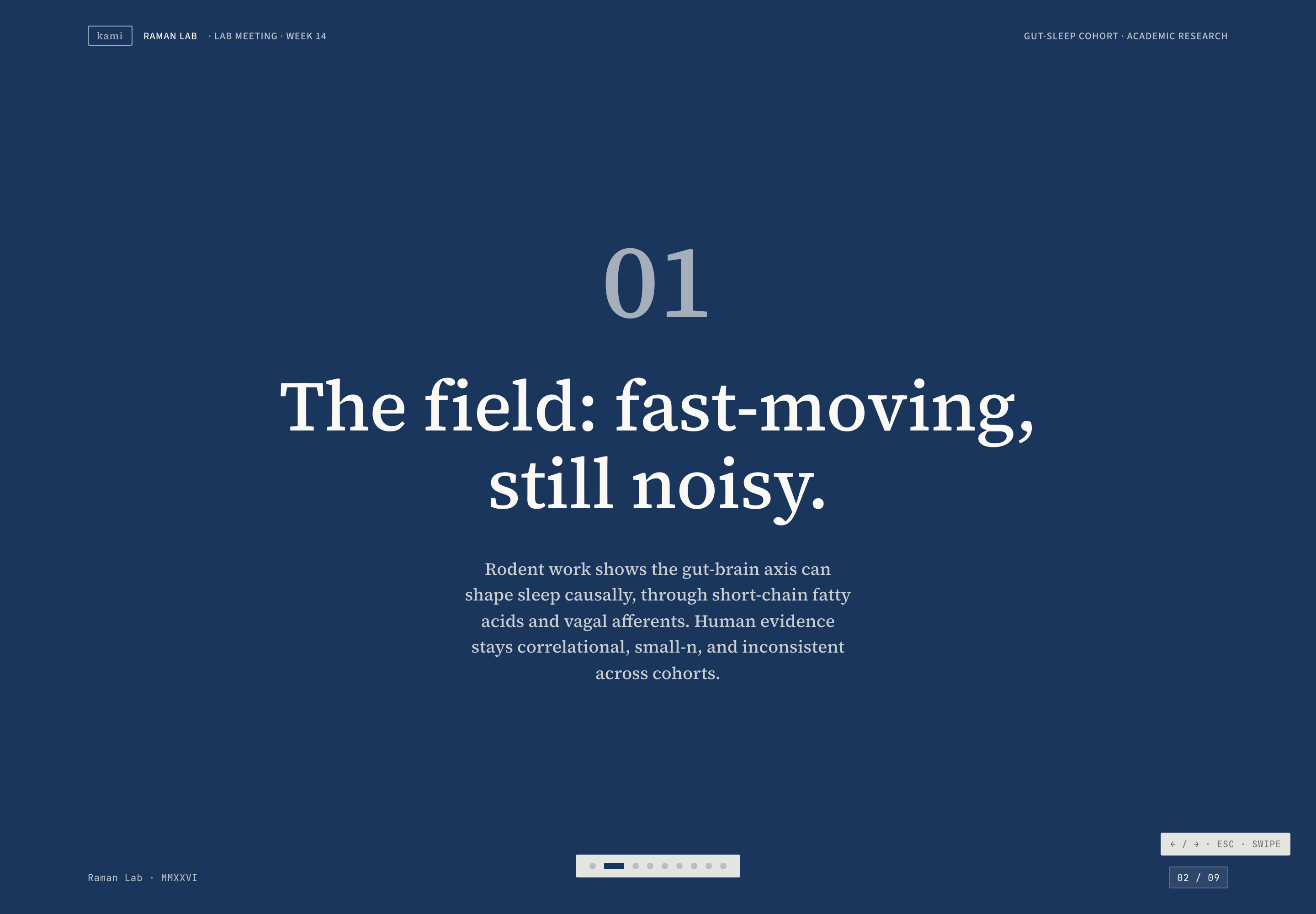
Microbiome Research Presentation Design
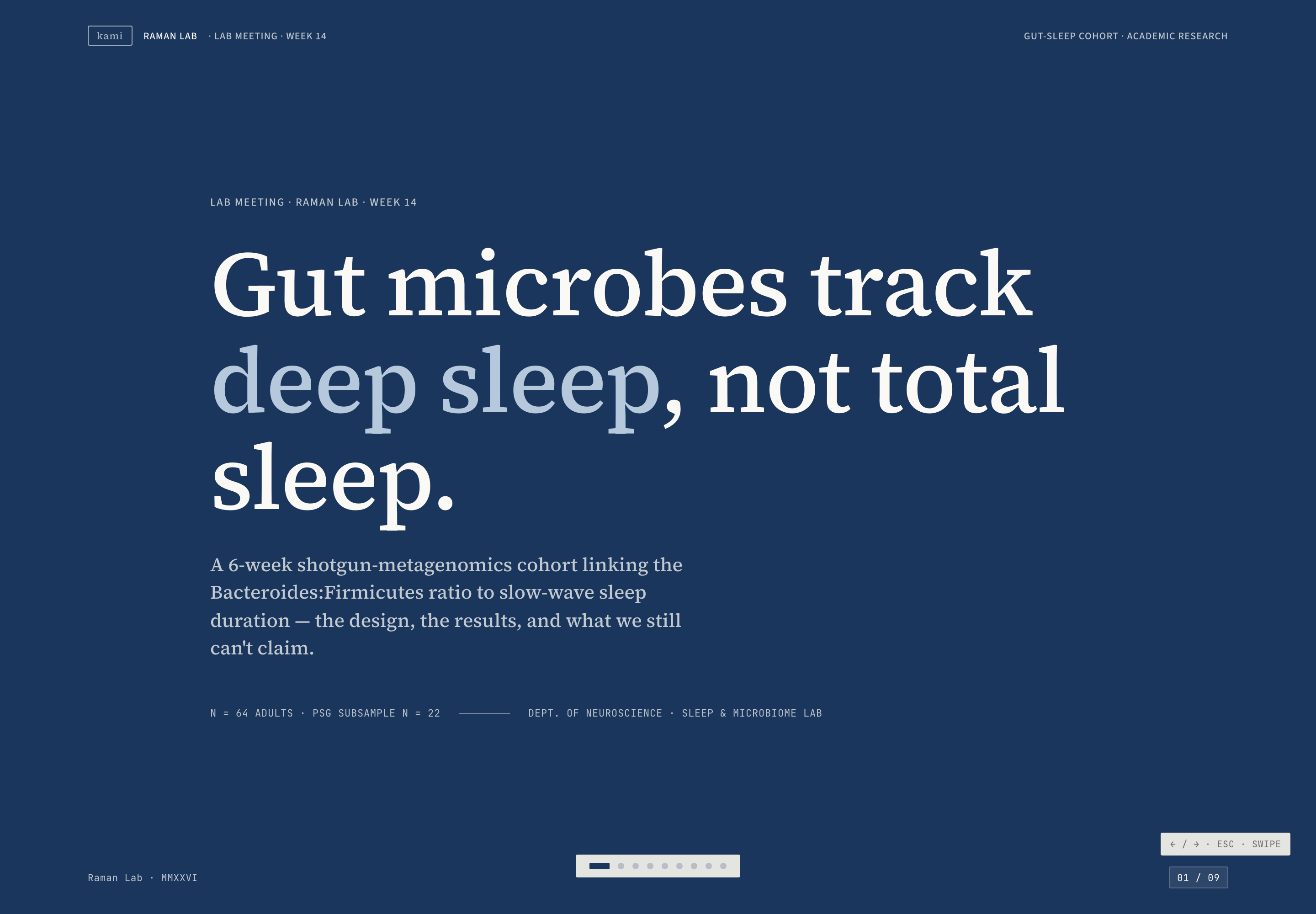
This official OpenDesign Community example is a nine-slide research presentation for a Raman Lab meeting about gut microbes and deep sleep. Its authored cover states, “Gut microbes track deep sleep, not total sleep,” then gives the audience a six-week cohort premise before the deck begins its argument.
The design uses navy, parchment cream, ivory, and muted blue, with Source Serif 4 headlines, Source Sans 3 body text, and JetBrains Mono metadata. The cover stacks its long research title in oversized lines. Below the abstract, a metadata line states “N = 64 adults” and “PSG subsample N = 22”; the footer instead identifies the lab and year.
Context Before Method
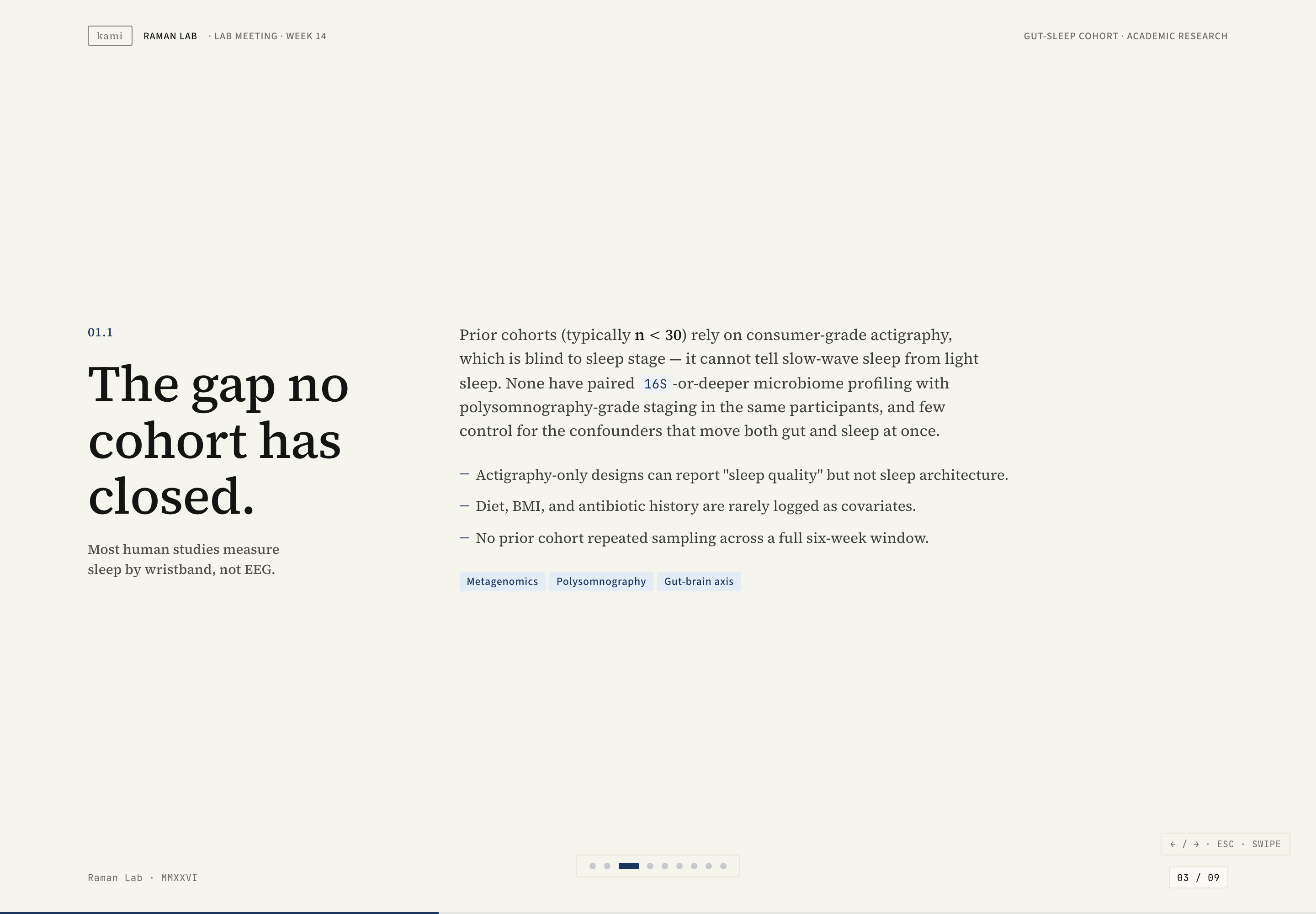
The sequence opens with “The field: fast-moving, still noisy.” and then “The gap no cohort has closed.” This gives a lab audience a reason to care before presenting the study design.
Evidence In Parallel
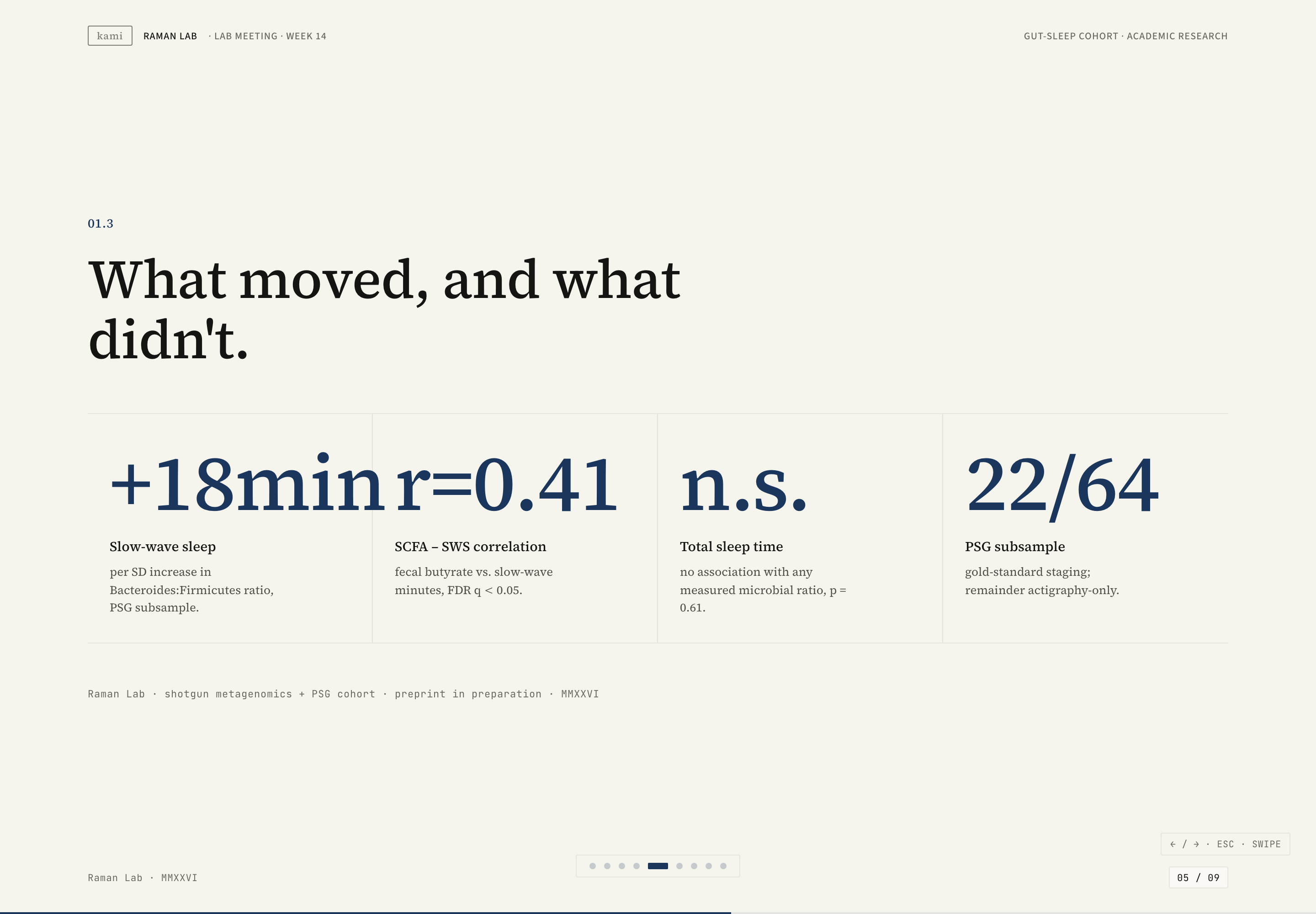
The results slide places “+18min,” “r=0.41,” “n.s.,” and “22/64” in four columns, separating a sample change, correlation, null result, and measurement coverage. In the supplied native-width capture, the first two large values overlap; the intended comparison needs more space before this layout is adapted.
Caution Before Action
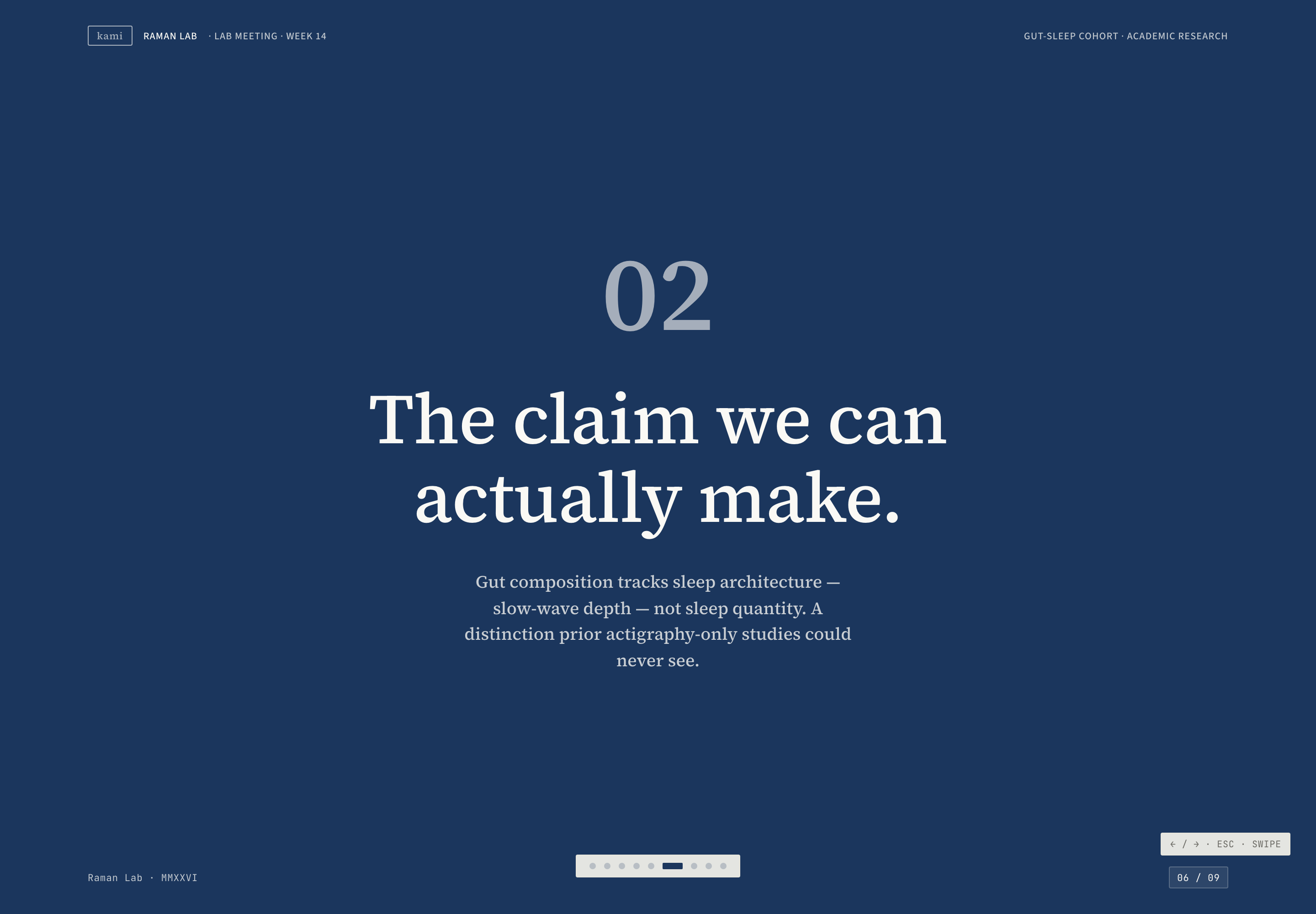
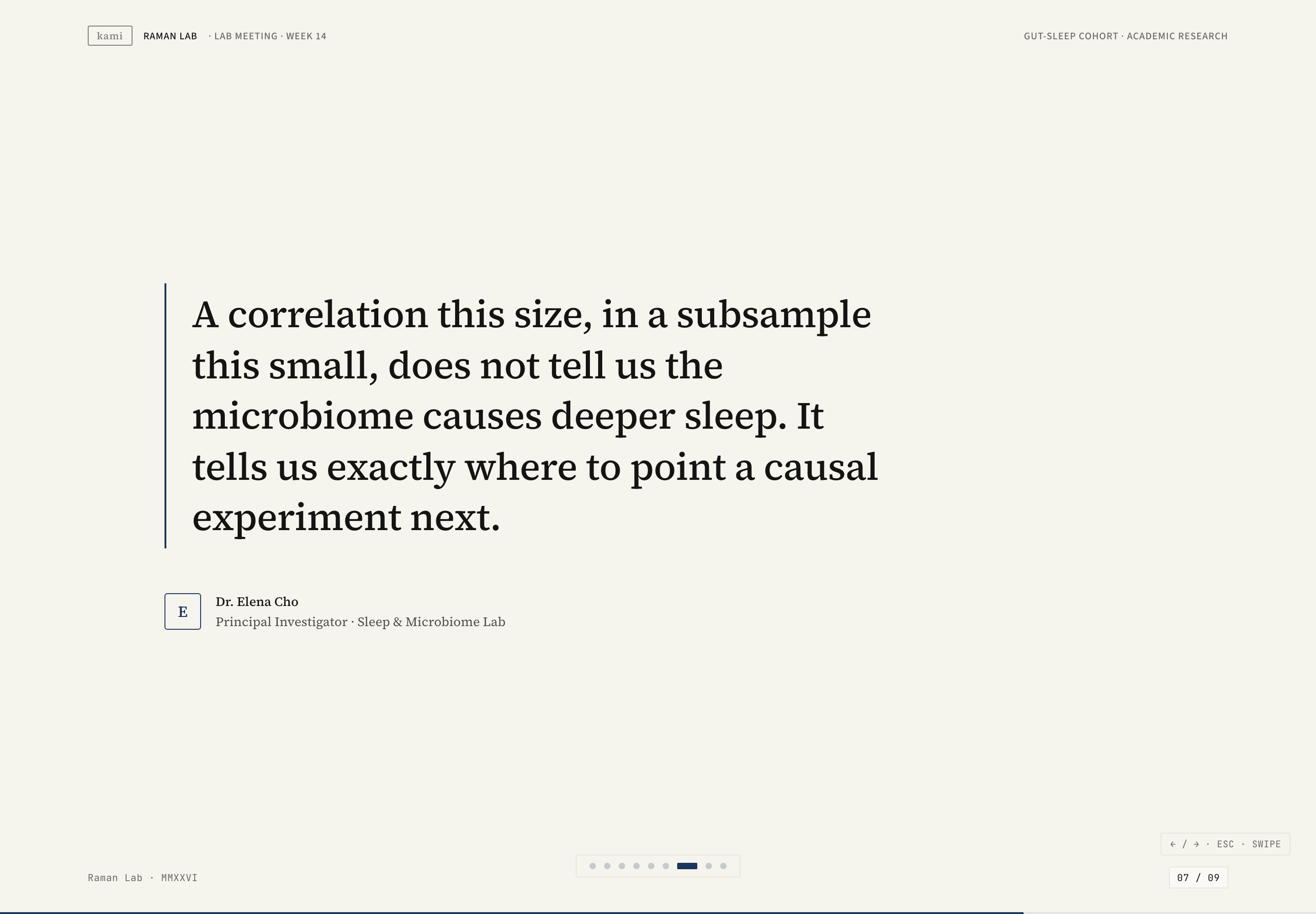
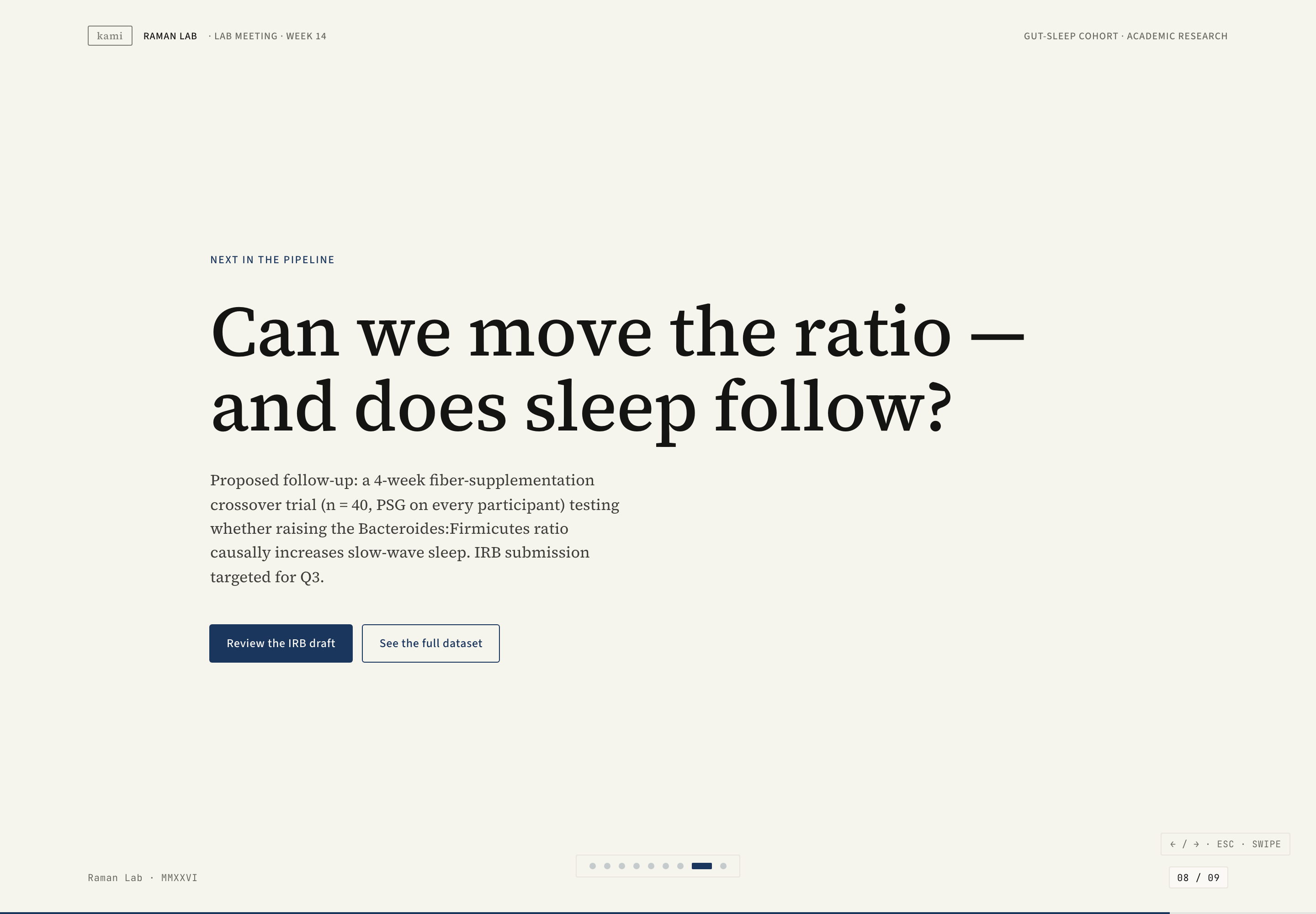
After “The claim we can actually make,” the deck adds a caveat about correlation and a proposed fiber-supplementation crossover trial. The narrative preserves uncertainty while still pointing toward a next question.
Lab Meeting Research Narratives
This slide system is suited to research teams that need to explain how a question became a study, what the measurements can support, and what remains unresolved. It is especially useful when the audience includes people who need both experimental detail and a concise meeting-level conclusion.
The deck’s audience path is visible in its labels: “Academic research,” “Lab meeting,” “The field,” “The gap,” “Design,” “What moved,” and “The claim.” Those labels are not interchangeable section names; together they establish a presentation rhythm that moves from shared background to a bounded interpretation.
For Methods Reviews
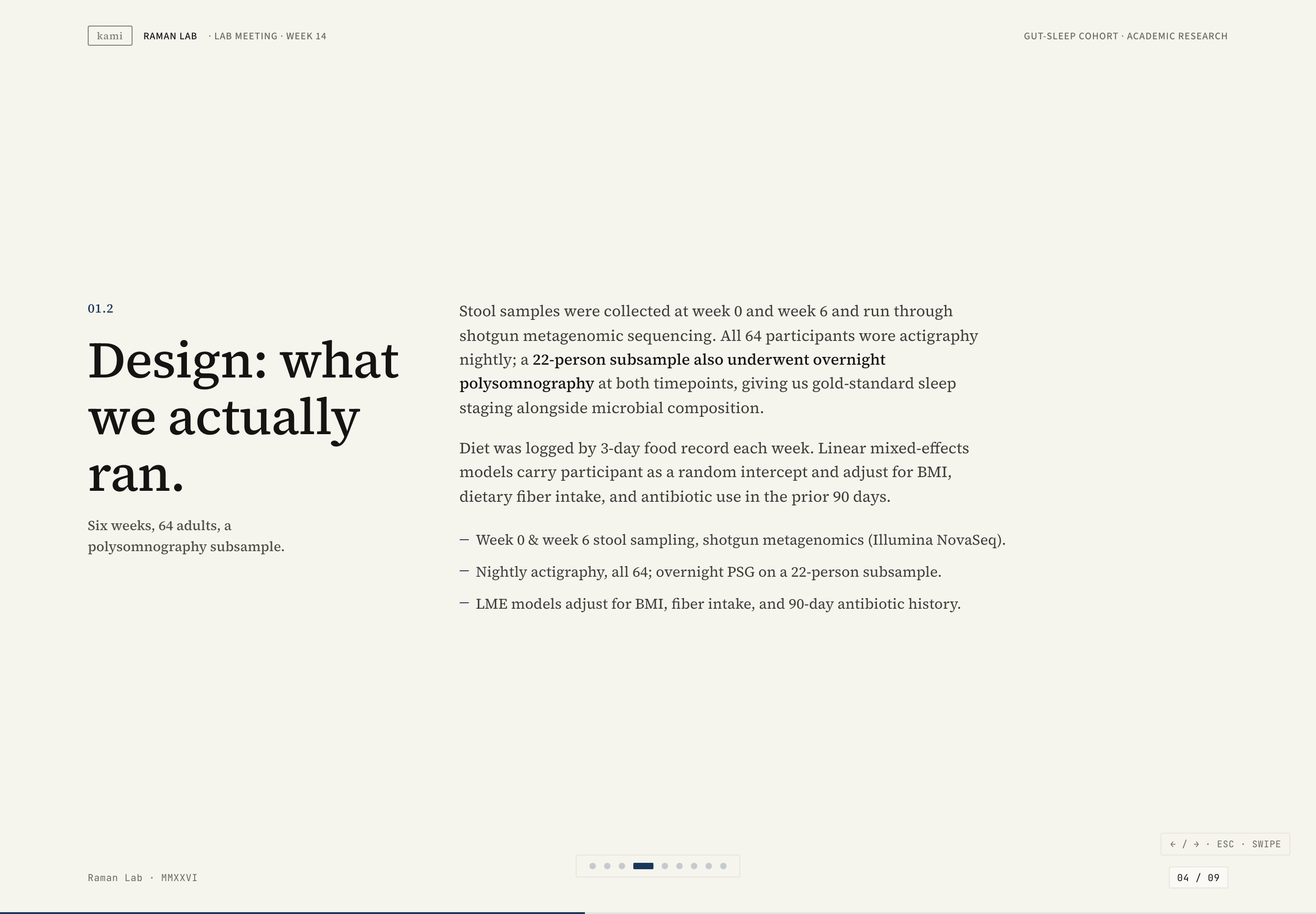
The design slide groups week 0 and week 6 stool sampling, nightly actigraphy, the 22-person PSG subsample, and model adjustments. That grouping helps an audience connect collection cadence, measurement quality, and covariates.
For Results Discussions
The results row distinguishes slow-wave sleep from total sleep time. This prevents a broad phrase such as “sleep quality” from absorbing two different outcomes.
For Follow-Up Planning
The next-pipeline slide proposes a four-week crossover trial with PSG on every participant. As shown, it functions as a discussion prompt for future work, not as evidence that the trial occurred.
From Research Gap To Next Experiment
The deck’s middle is deliberately denser than its opening and closing slides. Within the illustrative research scenario, the gap slide contrasts wristband actigraphy with EEG-based sleep staging, names missing controls, and describes the lack of repeated six-week sampling. Those authored claims motivate the next slide’s pairing of microbiome profiling with polysomnography; they are not independently established scientific findings.
The method slide answers that premise with a sample study definition: six weeks, 64 adults, week 0 and week 6 stool samples, nightly actigraphy, and a 22-person PSG subsample. It separates observations shown for all participants from sleep staging shown for the subsample. This is a useful way to communicate differing measurement coverage without treating the fictional study as validated research.
The results slide labels four distinct measures. Slow-wave sleep has a per-standard-deviation ratio statement; SCFA–SWS correlation names fecal butyrate and slow-wave minutes; total sleep time is marked as having no association; and PSG subsample states staging coverage. The labels retain the intended distinctions, but the oversized first two values overlap in the native-width capture. That visible spacing defect should be addressed in an adaptation rather than described as a clean, immediately comparable result.
Establish The Gap
Begin with the deck’s illustrative field and measurement gap, then explain why its proposed study pairs actigraphy with PSG. Keep that narrative premise distinct from verified scientific evidence.
Define Measurement Coverage
Present collection timing, participant counts, instruments, and model adjustments together. Keep all-participant measures distinct from the 22-person PSG subsample so scope is not mistaken for equivalence.
Bound The Claim
Follow the metric row with the deck’s illustrative interpretation about sleep architecture versus quantity, then put the correlation caveat before the proposed follow-up experiment. Do not present the sample conclusion as a scientific finding.
Illustrative Evidence And Capability Boundaries
The supplied content identifies the cohort, figures, scientific conclusion, and lab quote as illustrative source content. The slides can therefore be studied as a presentation design system, but their visible numbers and claims should not be treated as verified scientific findings, clinical evidence, or measured outcomes.
The HTML deck implements local navigation through keyboard commands, clickable slide dots, wheel or swipe gestures, and an overview. Those controls switch authored slides; they do not connect a research service. “Review the IRB draft” and “See the full dataset” are placeholder links with href="#", not document access, submissions, or verified datasets.
OpenDesign distributes this Community example, with Kami by tw93 credited as the declared template upstream. It is not presented as independently authored by OpenDesign. The bundled plugin manifest declares an MIT license; that declaration does not establish separate licensing for every depicted asset.
How to Create Microbiome Research Presentation Design in OpenDesign
Frame The Research Question
Start with a short lab-meeting premise that distinguishes the measured outcome from the broader topic. Use a cover, field divider, and research-gap slide before introducing methods.
Build The Evidence Sequence
Create a method slide that separates all-participant actigraphy from the PSG subsample, then create a four-column results row for slow-wave sleep, SCFA correlation, total sleep time, and sample coverage.
Suggested PromptCreate a nine-slide academic research presentation for a lab meeting about gut microbes and deep sleep. Use a navy-and-cream editorial system with large serif headlines, compact metadata, and a sequence covering the noisy field, the actigraphy-versus-PSG gap, a six-week cohort design, a four-column results row, a bounded claim, a correlation caveat, a proposed follow-up experiment, and a concise closing slide. Treat all names, figures, and scientific findings as illustrative design content; do not imply connected datasets, working submissions, or causal proof.
Refine The Claim And Handoff
Place the interpretation after the metric comparison, state what the visible evidence cannot establish, and end with a proposed next experiment. Check each number’s unit, relationship, and measurement scope. At the intended presentation width, ensure large values fit their columns; the supplied source’s first two results overlap.
Export and Get a Share Link
Export your finished design, then use Share in OpenDesign to get a share link. Open the link in a separate browser window and check that the intended version and its assets are available before sending it.
Brand Story Presentation Design
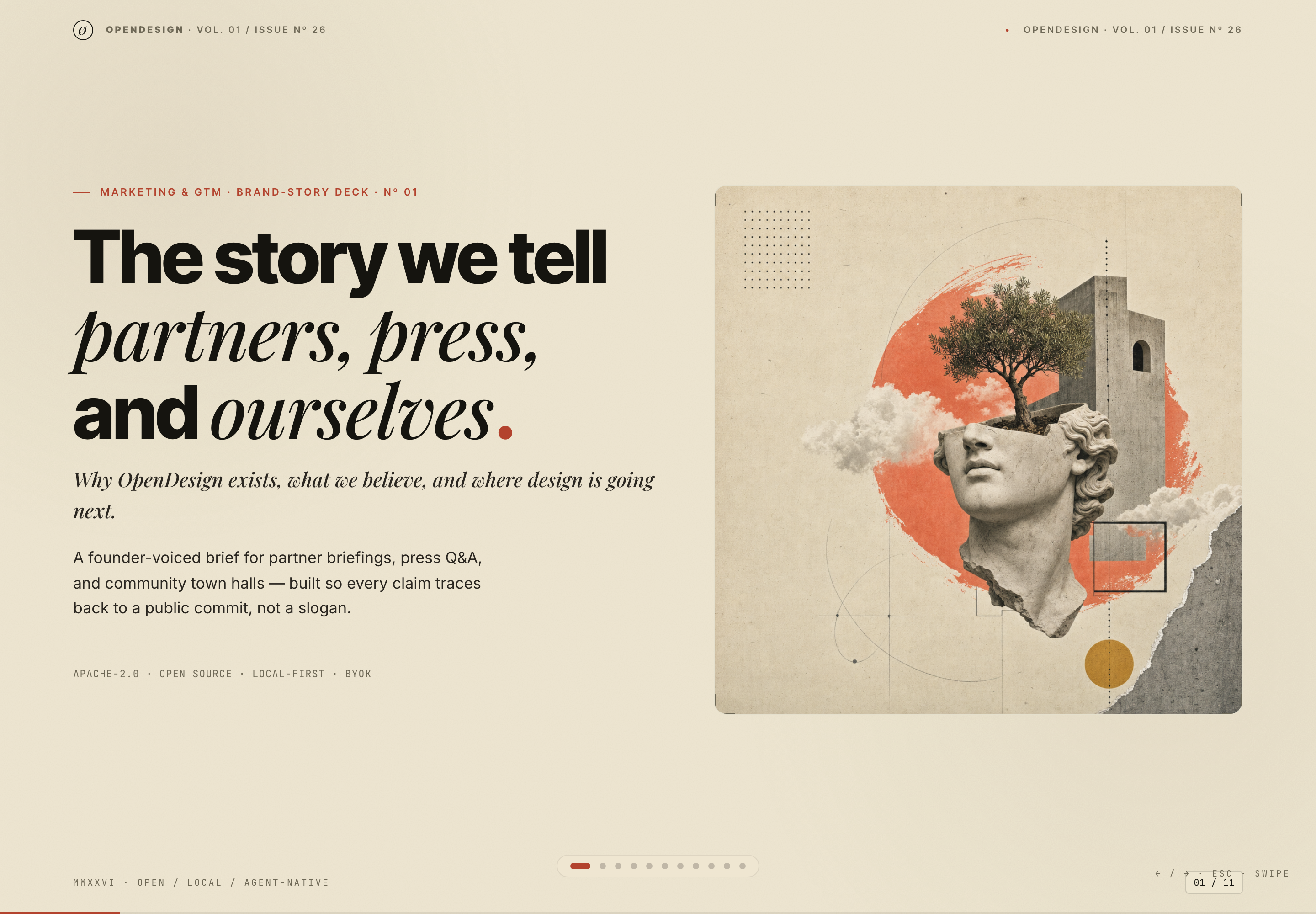
Brand Story Presentation Design gives partners, press, and community audiences one evidence-led narrative from belief to channels, calendar, and verification.
Slides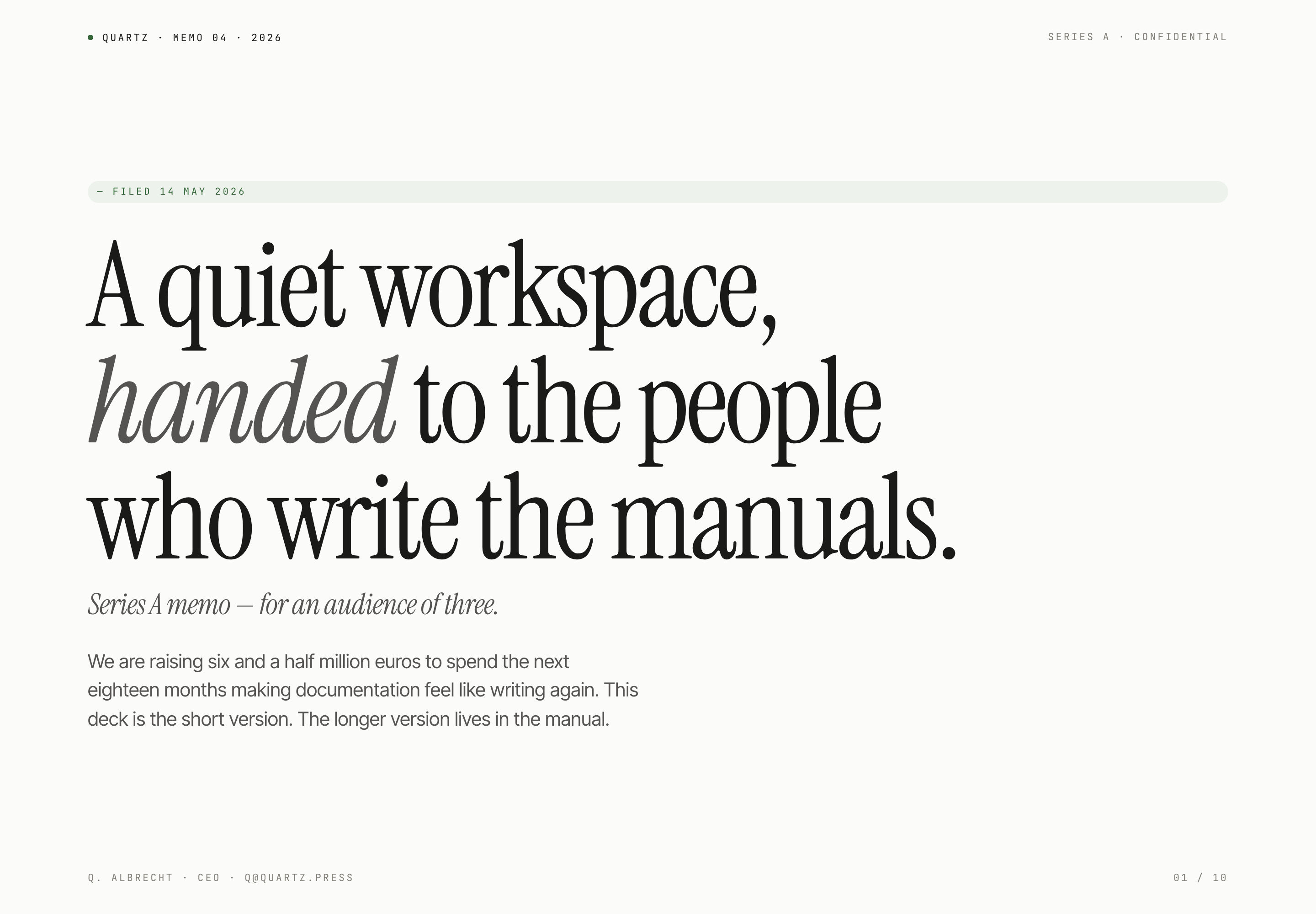
Fundraising Memo Presentation Design
Quartz's ten-slide fundraising memo pairs quiet serif typography with product principles, sample traction, and a funding request for a small investor audience.
Slides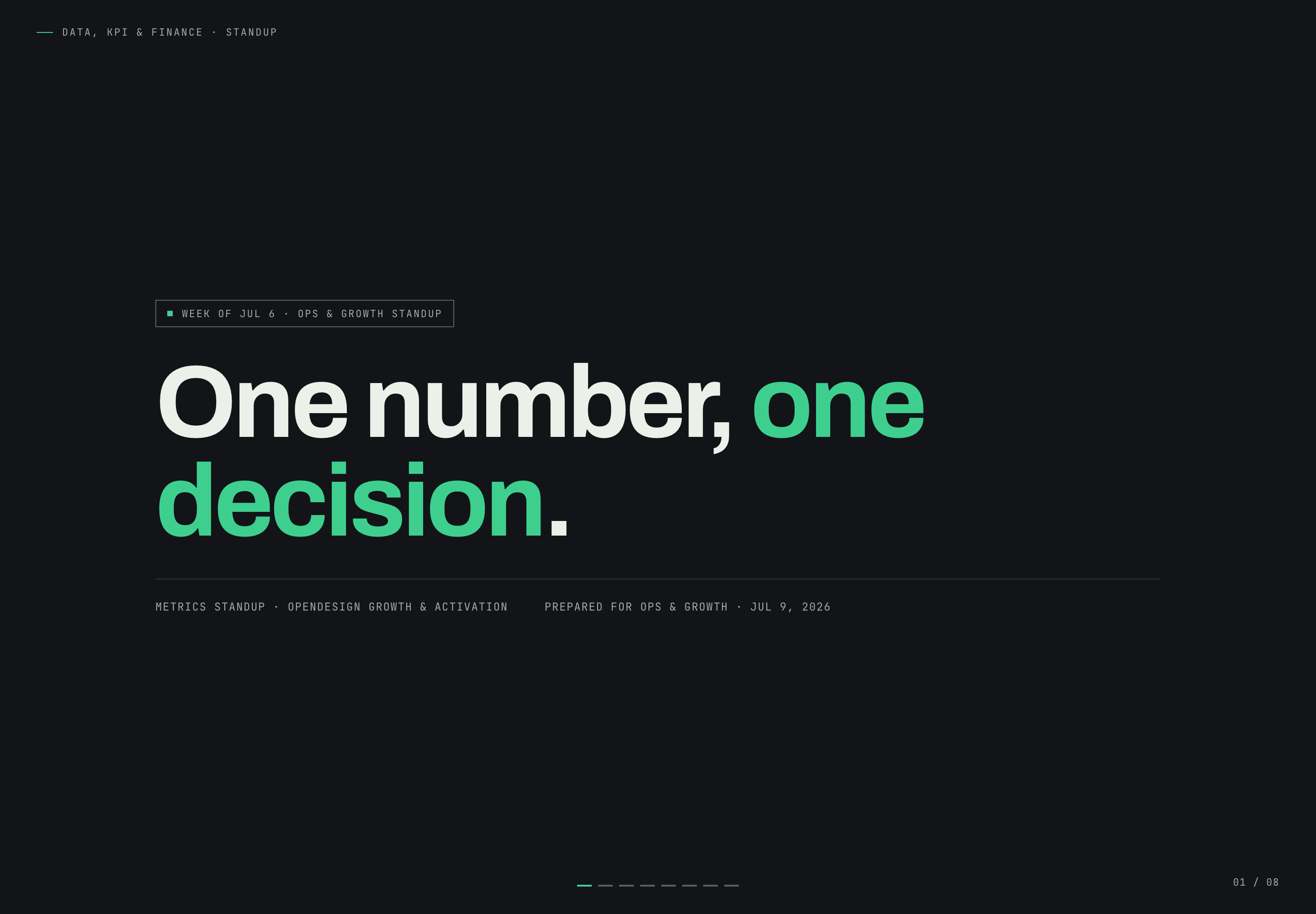
Growth Metrics Standup Design
Growth Metrics Standup Presentation Design turns a Safari conversion problem into a focused narrative that ends with one owned decision.
Slides
Incident Telemetry Presentation Design
Incident Telemetry — Operation Halcyon turns an illustrative runtime outage into an ordered briefing for tracing causes, risks, and decisions.
Slides