

Graphics
Authentication Product Specification Design
A Northwind two-factor authentication proposal links ownership, scope, user stories, four sample targets, rollout phases, and unresolved decisions.

Product Specification Use Cases
- Product Specification AuthorsTranslate authentication requirements into an ordered delivery brief.
- Identity Platform TeamsConnect security controls, rollout phases, and unresolved implementation decisions.
- Product And Design LeadsAlign ownership, scope, measures, and user-facing authentication priorities.
- Enterprise Readiness TeamsFrame customer security blockers alongside adoption and support considerations.
Authentication Brief Highlights
- Problem FramingConnects enterprise review blockers to the authentication gap.
- Explicit ScopeSeparates proposed launch goals from intentionally deferred work.
- Rollout TargetsPairs intended outcomes with sample targets and four rollout phases.
- Assigned QuestionsKeeps unresolved policy decisions visible with owners and dates.
The Product Specification, Section by Section
1 / 6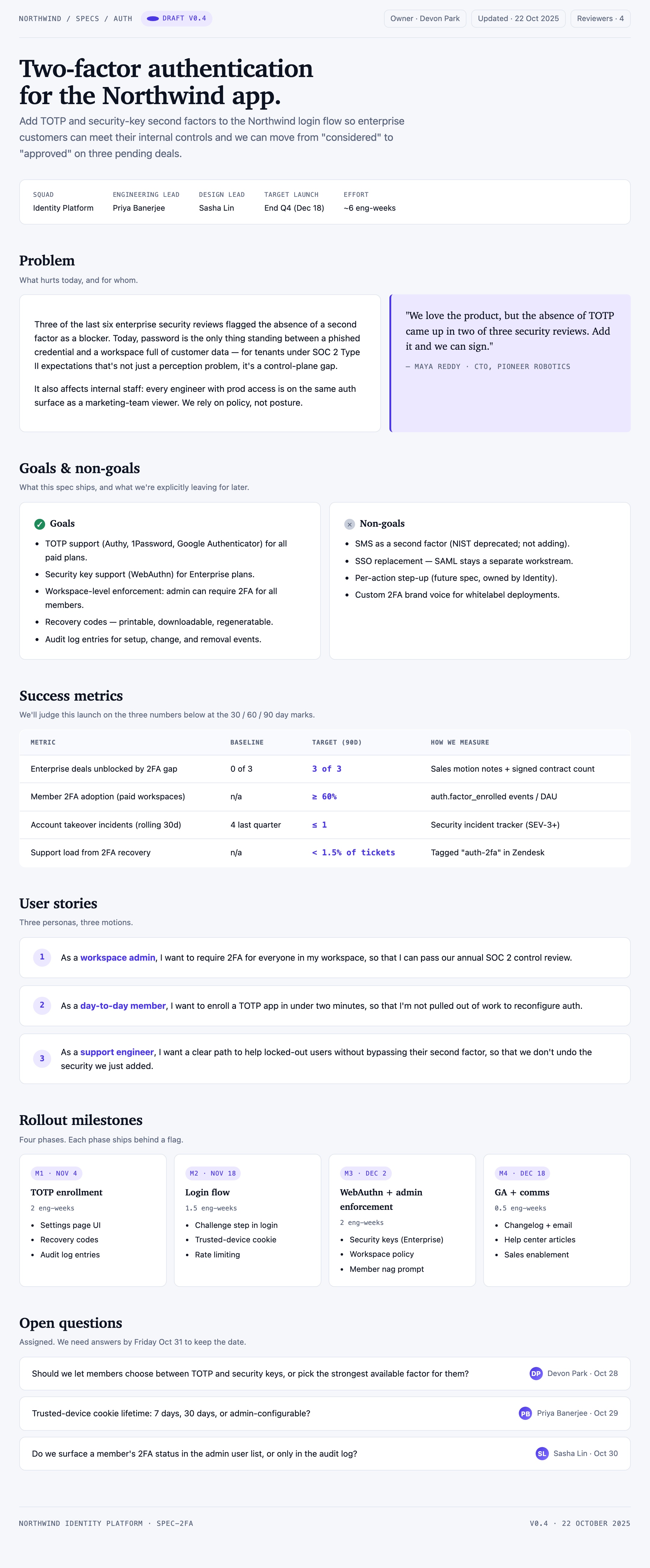
Northwind 2FA Brief
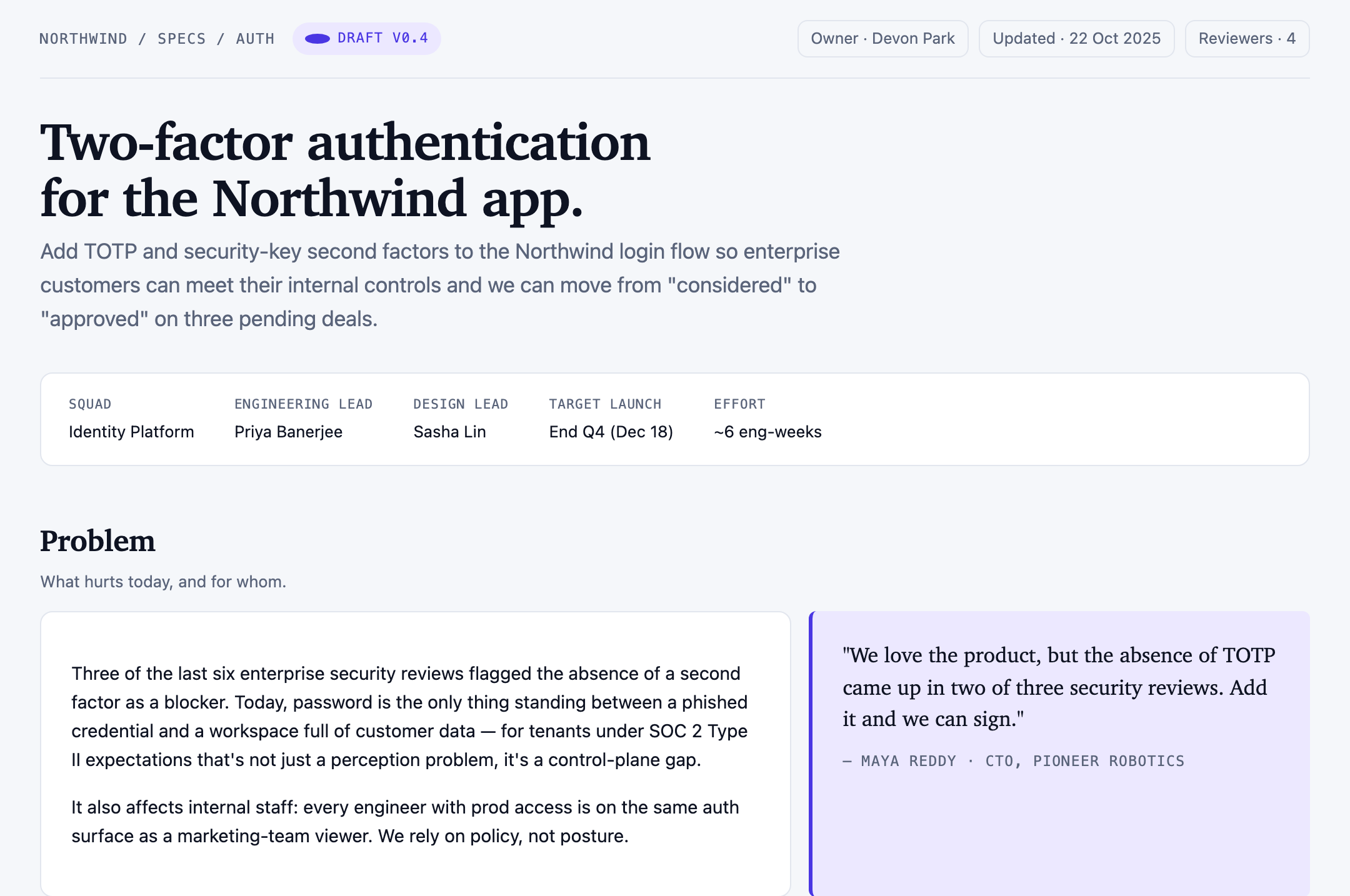
This official OpenDesign example is an illustrative product specification for two-factor authentication in the Northwind app. Its opening establishes the document as Draft v0.4, identifies the owner, update date, and four reviewers, then states the proposal: add TOTP and security-key factors to the login flow.
The visual composition puts that request before the planning detail. A metadata row names Identity Platform as the squad, Priya Banerjee as engineering lead, Sasha Lin as design lead, an End Q4 (Dec 18) target launch, and an estimated ~6 eng-weeks of effort. That ordering lets a reader understand ownership and delivery pressure before reading the problem.
The Problem section then gives the proposal a reason to exist. It describes three of the last six enterprise security reviews flagging the missing second factor, followed by a separate quote from Maya Reddy of Pioneer Robotics. The quote makes the commercial pressure legible without replacing the broader security argument.
Three Authentication Motions
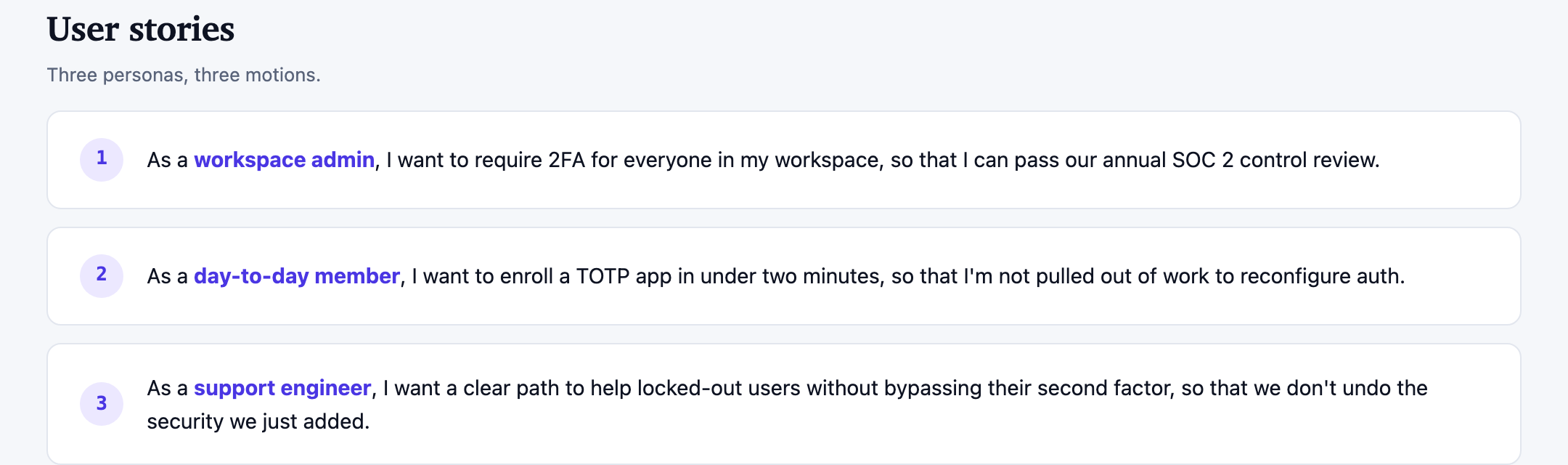
The sample User Stories section names three jobs: a workspace admin wants to require 2FA for a stated control-review objective; a day-to-day member wants TOTP enrollment in under two minutes; and a support engineer wants a recovery path that does not bypass the second factor. These are planning requirements in the document, not evidence that authentication works or compliance has been achieved.
These stories are presented as three numbered horizontal rows, with the persona phrase emphasized inside each sentence. That repeated structure makes the differences in responsibility easy to compare, while the “so that” clause preserves the operational reason behind each request.
The ordering also exposes a design tradeoff. Administration comes first because workspace enforcement defines the policy surface; enrollment follows because it is the member’s immediate action; recovery support comes last because it describes the exception path. The document therefore treats security as a shared system rather than only a login screen.
Workspace Admin
Requires 2FA for all members to support a control review.
Day-To-Day Member
Enrolls a TOTP app quickly without leaving normal work.
Support Engineer
Assists recovery without weakening the added security control.
Goals, Measures, And Phases
The document’s middle sequence moves from scope to evaluation to delivery. “Goals & non-goals” uses check and multiplication symbols to distinguish TOTP, WebAuthn, workspace enforcement, recovery codes, and audit entries from excluded work such as SMS, SSO replacement, per-action step-up, and custom white-label voice.
That split is useful because it prevents the proposal from treating every authentication request as part of this launch. The stated support for Authy, 1Password, and Google Authenticator gives the TOTP goal a concrete boundary, while WebAuthn is limited to Enterprise plans. The tradeoff is deliberate coverage: the spec gains an explicit first release while leaving adjacent identity work separate.
The Success Metrics table contains four sample planning rows: deals unblocked (3 of 3), paid-workspace adoption (at least 60%), rolling-30-day takeover incidents (at most 1), and recovery support load (less than 1.5% of tickets). These are targets, not measured outcomes. Its adoption formula counts enrollment events over DAU without defining unique-member deduplication, while the incident baseline says “4 last quarter.” The time windows and counting rules would need reconciliation before this table could measure a real launch.
Rollout Milestones turns those measures into four flagged phases: TOTP enrollment, the login flow, WebAuthn with admin enforcement, and GA plus communications. Each phase lists an effort estimate and concrete contents, so a reader can see which decisions affect settings, login, policy, and support materials.
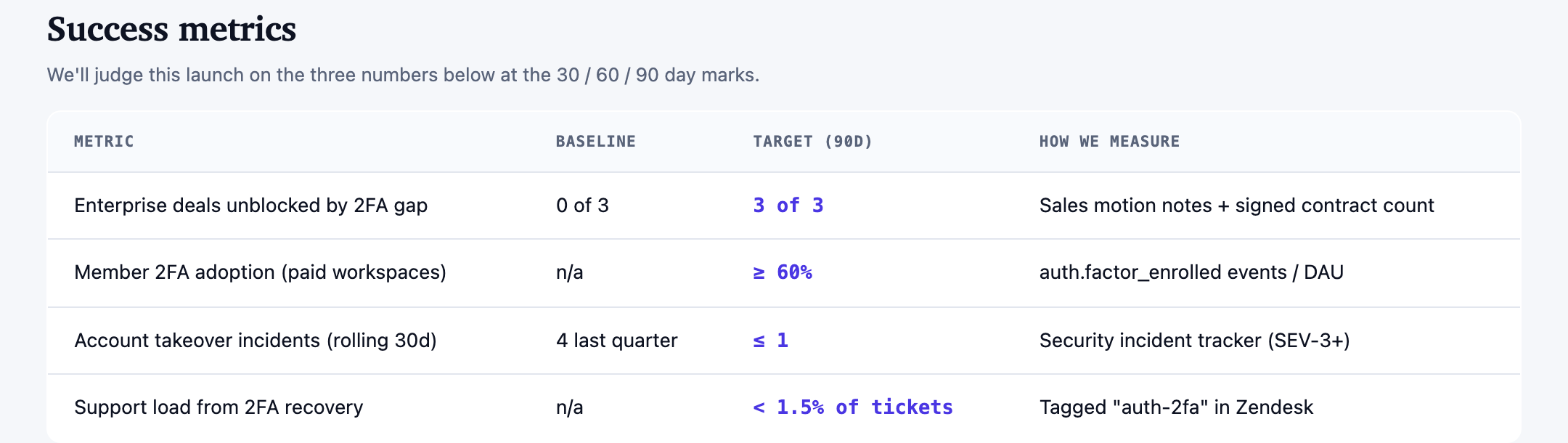
| Metric | Baseline | Target (90D) | Measurement Method |
|---|---|---|---|
| Enterprise deals unblocked by 2FA gap | 0 of 3 | 3 of 3 | Sales motion notes + signed contract count |
| Member 2FA adoption (paid workspaces) | n/a | ≥ 60% | auth.factor_enrolled events / DAU |
| Account takeover incidents (rolling 30d) | 4 last quarter | ≤ 1 | Security incident tracker (SEV-3+) |
| Support load from 2FA recovery | n/a | Less than 1.5% of tickets | Tagged auth-2fa in Zendesk |
Decisions Still Open
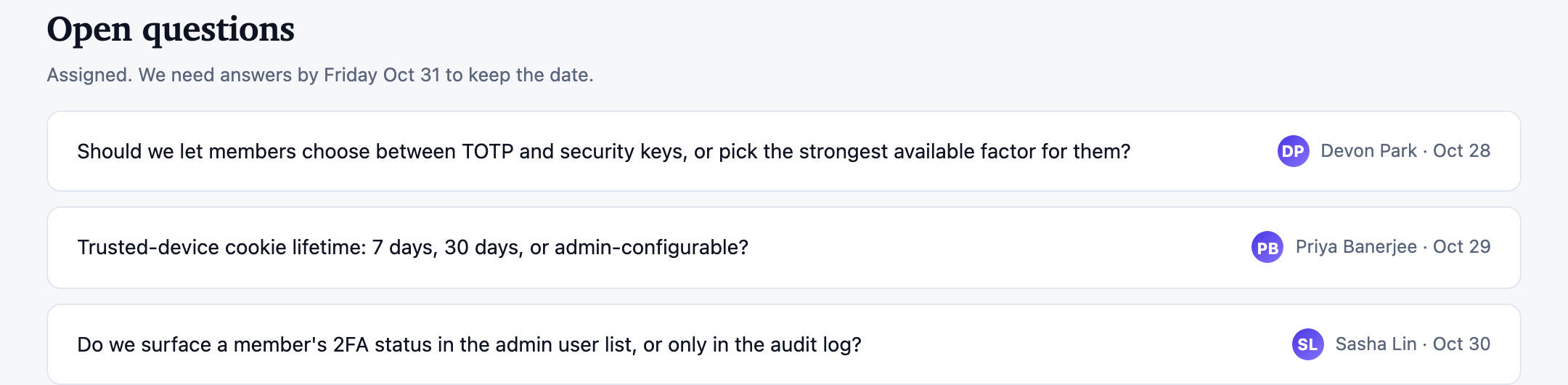
The final section keeps uncertainty visible instead of presenting the specification as finished implementation. Three questions are assigned to Devon Park, Priya Banerjee, and Sasha Lin on October 28, 29, and 30: whether members choose between TOTP and security keys, how long a trusted-device cookie should last, and where an admin can see a member’s 2FA status.
This is a meaningful counterpart to the milestone sequence. The rollout names a trusted-device cookie and admin enforcement, but the open questions show that their policy details are not settled in the document. Keeping those questions beside owners and dates gives the team a decision queue connected to the stated October 31 deadline.
Factor Choice
Decide whether members choose a factor or receive the strongest available one.
Trusted Device
Resolve the lifetime policy for the trusted-device cookie.
Admin Visibility
Choose between user-list status and audit-log visibility.
How to Create Authentication Product Specification Design in OpenDesign
Frame The Authentication Problem
Start with the product request, affected audience, and concrete security or commercial pressure. Include a compact ownership row with squad, leads, target launch, and effort when those details are known.
Define Scope And Measures
Separate proposed launch goals from non-goals, then add baselines, targets, and measurement methods. Keep planning values distinct from verified results, and align reporting windows and unique-user counting before adapting sample formulas.
Suggested PromptCreate a Northwind-style two-factor authentication product specification with a draft header, ownership row, Problem section, Goals and Non-goals, a four-column Success Metrics table, three numbered User Stories, four dated Rollout Milestones, and assigned Open Questions. Show TOTP, Enterprise WebAuthn, workspace enforcement, recovery codes, audit entries, and the stated capability limits; do not imply live services or measured outcomes.
Check The Decision Sequence
Review the document as a planning path: problem, scope, metrics, user stories, milestones, and open questions. Confirm that each milestone has concrete contents and that unresolved policy details remain visible rather than being presented as settled behavior.
Export and Get a Share Link
Export your finished design, then use Share in OpenDesign to get a share link. Open the link in a separate browser window and check that the intended version and its assets are available before sending it.
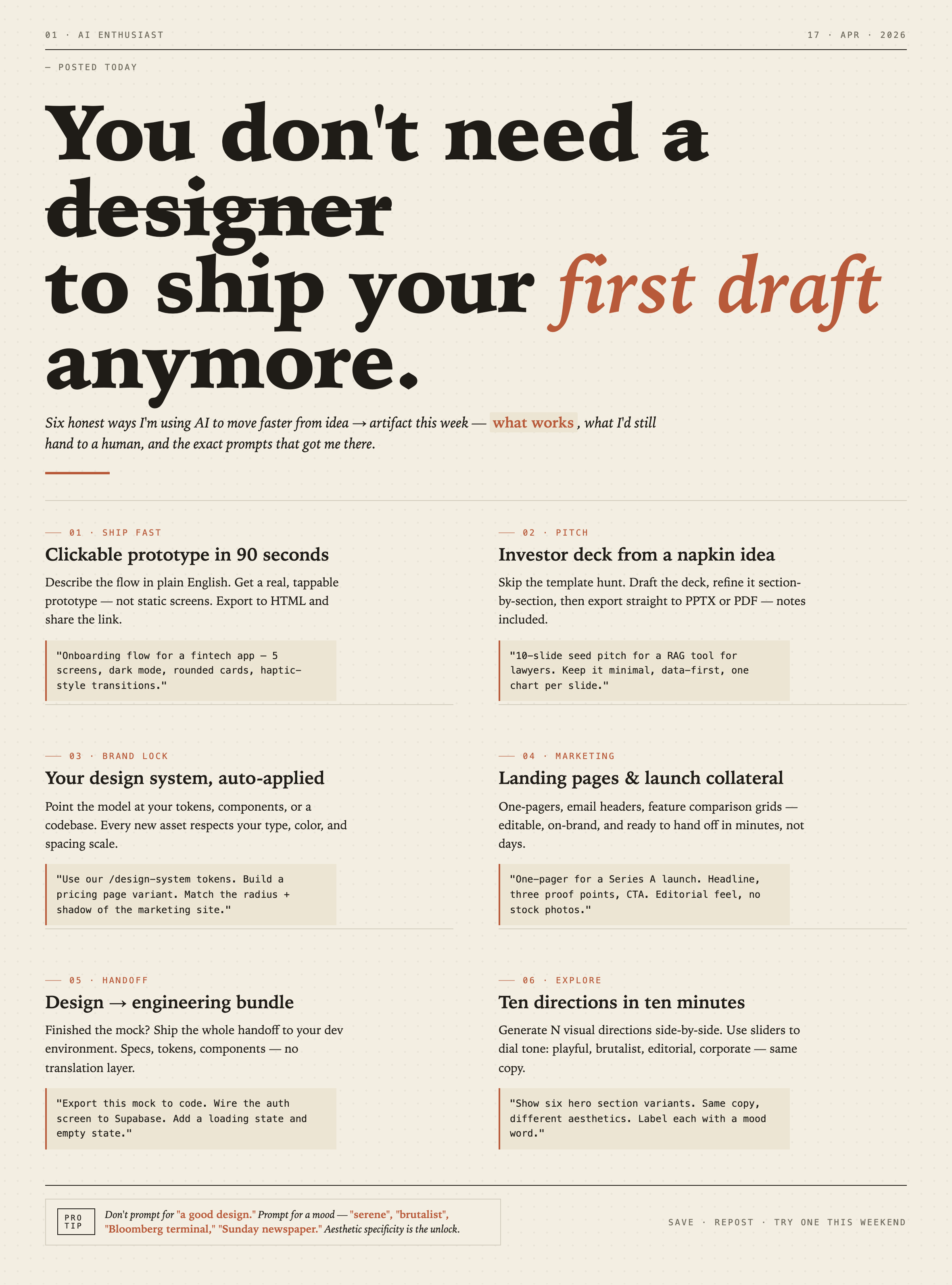
AI Workflow Editorial Poster Design
AI Workflow Editorial Poster Design presents six illustrated workflow claims with numbered chapters, concrete prompt specimens, and cream-and-rust typography.
Graphics
AI Workflow Social Carousel Design
Seven portrait cards use oversized Chinese headings, numbered habits, changing color fields, and a closing statement to explain AI editing workflows.
Graphics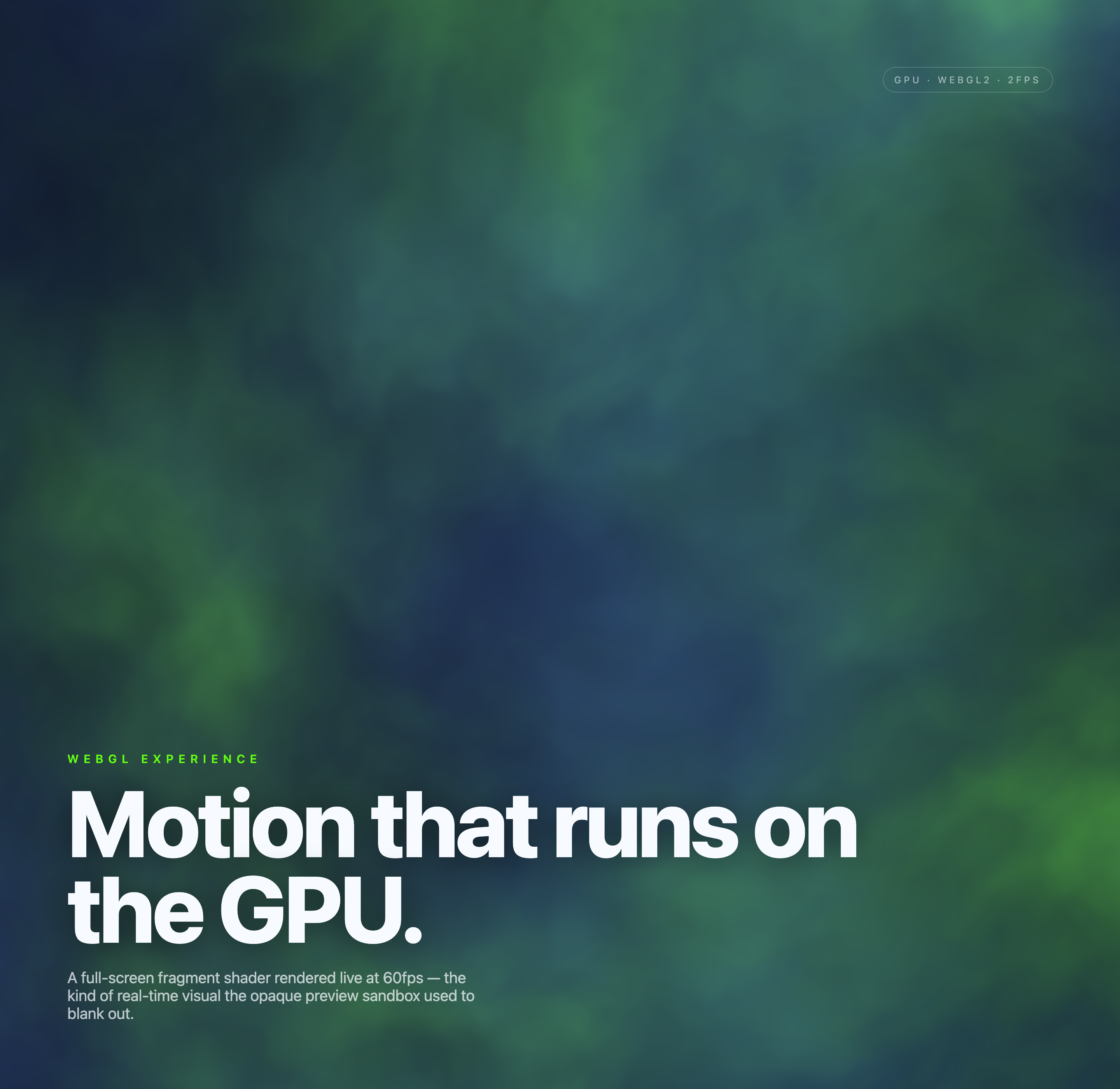
Aurora Field Shader Design
An automatically animated blue-green noise field gives a WebGL hero its atmosphere, while a fixed headline and small local frame-rate badge anchor the scene.
Graphics
Aurora Veil Shader Design
Aurora Veil is an interactive shader composition that turns layered light, stars, and cursor motion into an atmospheric WebGL hero.
Graphics